Germany visa and entry requirements

Germany is part of the Schengen Area: EU citizens travel freely, and Swiss and EEA nationals enter with a valid identity card or passport; nationals of the countries and territories on the EU's visa-exempt list (Annex II of Regulation (EU) 2018/1806) can stay up to 90 days in any 180-day period (the ETIAS travel authorisation is not yet in operation), and nationals of the countries on its visa-required list (Annex I) need a Schengen short-stay visa (standard fee €90 under the Visa Code), applied for before entry at the German mission abroad covering their place of residence.

Every fact on this page verified on or after: Aug 25, 2026· How this site works

Check requirements for your passport

Requirements differ by nationality. Select your passport above, or scan the full table below.

How long you can stay

90 days in any rolling 180-day period

90 days in any rolling 180-day period, counted across the whole Schengen Area rather than per country. The day you arrive counts as the first day and the day you leave counts as the last. Leaving and coming back does not reset the allowance: on any given day, days already spent anywhere in the area during the preceding 180 still count against the 90.

Work out your own dates in the stay calculator · Compare every country

Verified Oct 3, 2026 · Source: eur-lex.europa.eu (opens in a new tab) · Regulation (EU) 2018/1806, Article 4(1) · archived copy Jul 18, 2026 (opens in a new tab)

Visas & entry authorisations

Schengen short-stay visa

Fee
90 EUR
Processing
up to 45 days
Stay per entry
90 days

Children aged six to under 12: €45; under six: waived.

When to apply: Apply to the consulate at least 15 days before the journey and no earlier than 6 months before it.

Documents the application asks for

  • Valid passport — Expiring at least 3 months after you leave the Schengen area (for a multiple-entry visa, 3 months after you leave the last country visited)
  • Photo — Meeting ICAO standards
  • Medical insurance — Covering emergency medical care, hospitalisation and repatriation, including in the event of death
  • Supporting documents — On the purpose of the stay, your financial means and accommodation, and your intention to return home

Schengen short-stay visa — European Union and Azerbaijan visa facilitation agreement

Fee
35 EUR
Processing
up to 30 days
Stay per entry
90 days

Set by the EU–Azerbaijan visa facilitation agreement (Article 6); waived for pensioners and children under 12, among other listed categories.

Schengen short-stay visa — European Union and Belarus visa facilitation agreement

Fee
35 EUR
Processing
up to 30 days
Stay per entry
90 days

Set by the EU–Belarus visa facilitation agreement (Article 6); €70 when the applicant asks for a decision within two days and the consulate accepts; waived for children under 12, among other listed categories. Council Decision (EU) 2021/1940 suspends some of the agreement's provisions.

Schengen short-stay visa — European Union and Cabo Verde short-stay visa agreement

Fee
67.5 EUR
Processing
up to 45 days
Stay per entry
90 days

Set by the EU–Cabo Verde visa facilitation agreement as amended (Article 5) at 75% of the fee charged under the applicable legislation; children aged 12 to under 18 are charged 50% of that fee, and children under 12 are exempt, among other listed categories.

Schengen short-stay visa for Russian nationals

Fee
90 EUR
Processing
up to 45 days
Stay per entry
90 days

Standard fee under the Visa Code (Article 16): children aged six to under 12 pay €45 and children under six pay nothing. The EU–Russia visa facilitation agreement is suspended in whole for Russian citizens (Council Decision (EU) 2022/1500). The European Commission says Russian nationals will no longer be able to receive multiple-entry visas, while allowing exceptions for limited and justified cases such as independent journalists and human rights defenders.

When to apply: Apply to the consulate at least 15 days before the journey and no earlier than 6 months before it.

Documents the application asks for

  • Valid passport — Expiring at least 3 months after you leave the Schengen area (for a multiple-entry visa, 3 months after you leave the last country visited)
  • Photo — Meeting ICAO standards
  • Medical insurance — Covering emergency medical care, hospitalisation and repatriation, including in the event of death
  • Supporting documents — On the purpose of the stay, your financial means and accommodation, and your intention to return home

National visa (category D)

Fee
75 EUR
Processing
—

The Federal Foreign Office describes national category D visas as issued for long-term visits of more than three months. The Residence Ordinance (AufenthV § 46) sets the fee at €75, also for multiple entries. Long-stay visas have a period of validity of no more than one year (Regulation (EU) No 265/2010).

Entry requirements

Passport validity

Under the Schengen Borders Code (Article 6(1)(a)), a non-EU visitor's passport must remain valid for at least 3 months after the intended date of departure from the Schengen Area (this may be waived in a justified case of emergency) and must have been issued within the previous 10 years.

At least 2 blank pages required. Compare every country

Vaccinations

Not officially stated

No official source we read lists a vaccination certificate required for entry.

Travel insurance

Required

Schengen visa applicants must prove they hold adequate and valid travel medical insurance, valid throughout the Schengen Area for the whole intended stay, with minimum coverage of €30,000. The Federal Foreign Office advises visitors who do not need a visa to take out health insurance before the trip that also covers return transport to their home country.

Onward or return ticket

Not officially stated

Under the Schengen Borders Code, the non-exhaustive list of supporting documents a border guard may request (Annex I) includes, as regards return, a return or round-trip ticket. The UK government says British visitors may need to show a return or onward ticket at German border control.

Verified Oct 3, 2026 · Source: eur-lex.europa.eu (opens in a new tab) · Regulation (EU) 2016/399 (Schengen Borders Code), Article 6(1)(c)

Proof of funds

Required

Under the Schengen Borders Code (Article 6(1)(c)), non-EU visitors must have sufficient means of subsistence for the intended stay and for the return, or be in a position to acquire such means lawfully. Germany's Federal Foreign Office says proof may have to be provided, that the amount depends on the type and length of stay, and that there are no fixed daily rates.

Verified Oct 9, 2026 · Source: eur-lex.europa.eu (opens in a new tab) · Regulation (EU) 2016/399, Article 6(1)(c) · home-affairs.ec.europa.eu (opens in a new tab) says €45 a day. We follow the source above: it ranks higher (law, then the authority running the procedure, then the destination's ministry, then international compilations, then other governments' advice).

Arrival cards & declarations

Required
  • EES — Entry/Exit System (biometric registration) — The UK Foreign Office says that on short stays in the Schengen Area you may need to register biometric details such as fingerprints and a photo in the EU Entry/Exit System, that on your first visit you may be asked to do this at a special booth before the immigration desk, that there is no cost for EES registration, and that you need take no action before you arrive at the border. (at the border on first entry) travel-europe.europa.eu (opens in a new tab)
  • ETIAS — European Travel Information and Authorization System — The 30 European countries covered by ETIAS will require visa-exempt travellers to have an ETIAS travel authorisation. It is currently not in operation and no applications are being collected; the EU will announce the start date several months before launch. The official ETIAS website is travel-europe.europa.eu. (before travel, once etias starts) travel-europe.europa.eu (opens in a new tab)

Staying past your permitted stay

Whoever stays in Germany without the required residence title while enforceably obliged to leave, with no departure period granted or the period expired, and whose deportation is not suspended, is punishable by imprisonment of up to one year or a fine. Committing this negligently is an administrative offence punishable by a fine of up to three thousand euros.

Customs & currency

Cash of €10,000 or more (or its equivalent in other currencies) must be declared to customs when entering or leaving the EU.

  • Entering from outside the EU, the EU's Your Europe portal gives a duty-free allowance of 4 litres of still wine and 16 litres of beer, plus 1 litre of spirits over 22% vol. (or 2 litres of fortified or sparkling wine); 200 cigarettes (or 100 cigarillos, 50 cigars or 250 g of tobacco) where the higher tobacco limit applies, since a higher or lower limit may apply depending on the EU country; and other goods worth up to €300, or €430 for travellers by air and sea.
  • Arriving from another EU country, Your Europe says no further payments are due on alcohol and tobacco bought for your own use and not for resale. Each EU country sets guideline quantities, which may not be lower than, for example, 800 cigarettes or 10 litres of spirits; if customs suspect goods are not for your own use, you may be asked to prove that they are.

Country in a nutshell

Currency
Euro (EUR, €)
Safety — Generally safe
The UK Foreign Office says crime levels in Germany are similar to the UK's, and advises taking sensible precautions against mugging, bag-snatching and pickpocketing, particularly at airports, railway stations and in crowded public places.Verified Oct 6, 2026 · Source: gov.uk (opens in a new tab)
Power plugs
C, F · 230V 50Hz
Emergency numbers
General emergencies: 112 · Police: 110
Languages
German
Time zone
UTC+1 (UTC+2 in summer)
International Driving Permit

Germany is a party to the 1968 Vienna Convention on Road Traffic (UN Treaty Collection). Germany's Driving Licence Regulation (§ 29 FeV) lets holders of a foreign licence drive in Germany within its scope as long as they have no ordinary residence there; once they take up residence, a non-EU/EEA licence remains valid for six more months. A national licence not in German, not issued in the EU/EEA or Switzerland and not matching Annex 6 of the 1968 Convention must be accompanied by a translation made by an internationally recognised automobile club of the issuing country or a body designated by the Federal Transport Ministry, unless Germany has waived this.

Verified Oct 3, 2026 · Source: treaties.un.org (opens in a new tab) · Convention on Road Traffic · archived copy Aug 25, 2026 (opens in a new tab) Compare every country

Tips & warnings

The official ETIAS website, travel-europe.europa.eu, gives the application fee as EUR 20.

Visa requirements by nationality

Visa requirements by nationality. Stay lengths are for ordinary tourist visits. Click a nationality for its full guide.
PassportsVisas & entry authorisationsMax stay
AfghanistanEmbassy visa—
AlbaniaVisa-free90 days
AlgeriaEmbassy visa—
AndorraVisa-free90 days
AngolaEmbassy visa—
Antigua and BarbudaVisa-free90 days
ArgentinaVisa-free90 days
ArmeniaEmbassy visa—
AustraliaVisa-free90 days
AustriaFree movement—
AzerbaijanEmbassy visa—
BahamasVisa-free90 days
BahrainEmbassy visa—
BangladeshEmbassy visa—
BarbadosVisa-free90 days
BelarusEmbassy visa—
BelgiumFree movement—
BelizeEmbassy visa—
BeninEmbassy visa—
BhutanEmbassy visa—
BoliviaEmbassy visa—
Bosnia and HerzegovinaVisa-free90 days
BotswanaEmbassy visa—
BrazilVisa-free90 days
BruneiVisa-free90 days
BulgariaFree movement—
Burkina FasoEmbassy visa—
BurundiEmbassy visa—
Cabo VerdeEmbassy visa—
CambodiaEmbassy visa—
CameroonEmbassy visa—
CanadaVisa-free90 days
Central African RepublicEmbassy visa—
ChadEmbassy visa—
ChileVisa-free90 days
ChinaEmbassy visa—
ColombiaVisa-free90 days
ComorosEmbassy visa—
Costa RicaVisa-free90 days
Côte d'IvoireEmbassy visa—
CroatiaFree movement—
CubaEmbassy visa—
CyprusFree movement—
CzechiaFree movement—
Democratic Republic of the CongoEmbassy visa—
DenmarkFree movement—
DjiboutiEmbassy visa—
DominicaVisa-free90 days
Dominican RepublicEmbassy visa—
EcuadorEmbassy visa—
EgyptEmbassy visa—
El SalvadorVisa-free90 days
Equatorial GuineaEmbassy visa—
EritreaEmbassy visa—
EstoniaFree movement—
EswatiniEmbassy visa—
EthiopiaEmbassy visa—
FijiEmbassy visa—
FinlandFree movement—
FranceFree movement—
GabonEmbassy visa—
GambiaEmbassy visa—
GeorgiaVisa-free90 days
GermanyFree movement—
GhanaEmbassy visa—
GreeceFree movement—
GrenadaVisa-free90 days
GuatemalaVisa-free90 days
GuineaEmbassy visa—
Guinea-BissauEmbassy visa—
GuyanaEmbassy visa—
HaitiEmbassy visa—
HondurasVisa-free90 days
Hong KongVisa-free90 days
HungaryFree movement—
IcelandFree movement—
IndiaEmbassy visa—
IndonesiaEmbassy visa—
IranEmbassy visa—
IraqEmbassy visa—
IrelandFree movement—
IsraelVisa-free90 days
ItalyFree movement—
JamaicaEmbassy visa—
JapanVisa-free90 days
JordanEmbassy visa—
KazakhstanEmbassy visa—
KenyaEmbassy visa—
KiribatiVisa-free90 days
KosovoVisa-free90 days
KuwaitEmbassy visa—
KyrgyzstanEmbassy visa—
LaosEmbassy visa—
LatviaFree movement—
LebanonEmbassy visa—
LesothoEmbassy visa—
LiberiaEmbassy visa—
LibyaEmbassy visa—
LiechtensteinFree movement—
LithuaniaFree movement—
LuxembourgFree movement—
MacauVisa-free90 days
MadagascarEmbassy visa—
MalawiEmbassy visa—
MalaysiaVisa-free90 days
MaldivesEmbassy visa—
MaliEmbassy visa—
MaltaFree movement—
Marshall IslandsVisa-free90 days
MauritaniaEmbassy visa—
MauritiusVisa-free90 days
MexicoVisa-free90 days
MicronesiaVisa-free90 days
MoldovaVisa-free90 days
MonacoVisa-free90 days
MongoliaEmbassy visa—
MontenegroVisa-free90 days
MoroccoEmbassy visa—
MozambiqueEmbassy visa—
MyanmarEmbassy visa—
NamibiaEmbassy visa—
NauruEmbassy visa—
NepalEmbassy visa—
NetherlandsFree movement—
New ZealandVisa-free90 days
NicaraguaVisa-free90 days
NigerEmbassy visa—
NigeriaEmbassy visa—
North KoreaEmbassy visa—
North MacedoniaVisa-free90 days
NorwayFree movement—
OmanEmbassy visa—
PakistanEmbassy visa—
PalauVisa-free90 days
PalestineEmbassy visa—
PanamaVisa-free90 days
Papua New GuineaEmbassy visa—
ParaguayVisa-free90 days
PeruVisa-free90 days
PhilippinesEmbassy visa—
PolandFree movement—
PortugalFree movement—
QatarEmbassy visa—
Republic of the CongoEmbassy visa—
RomaniaFree movement—
RussiaEmbassy visa—
RwandaEmbassy visa—
Saint Kitts and NevisVisa-free90 days
Saint LuciaVisa-free90 days
Saint Vincent and the GrenadinesVisa-free90 days
SamoaVisa-free90 days
San MarinoVisa-free90 days
São Tomé and PríncipeEmbassy visa—
Saudi ArabiaEmbassy visa—
SenegalEmbassy visa—
SerbiaVisa-free90 days
SeychellesVisa-free90 days
Sierra LeoneEmbassy visa—
SingaporeVisa-free90 days
SlovakiaFree movement—
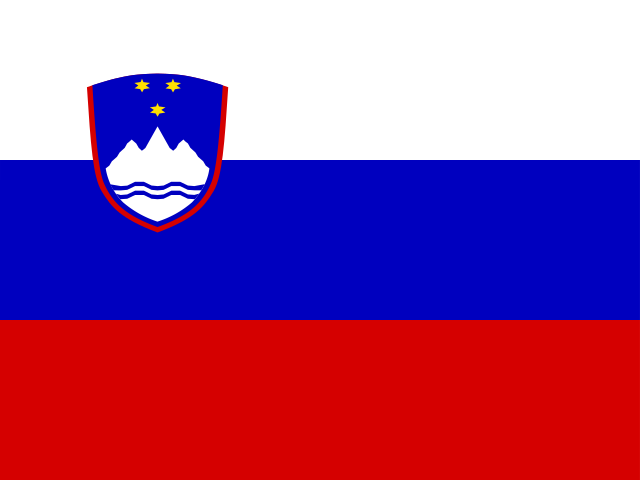
SloveniaFree movement—
Solomon IslandsVisa-free90 days
SomaliaEmbassy visa—
South AfricaEmbassy visa—
South KoreaVisa-free90 days
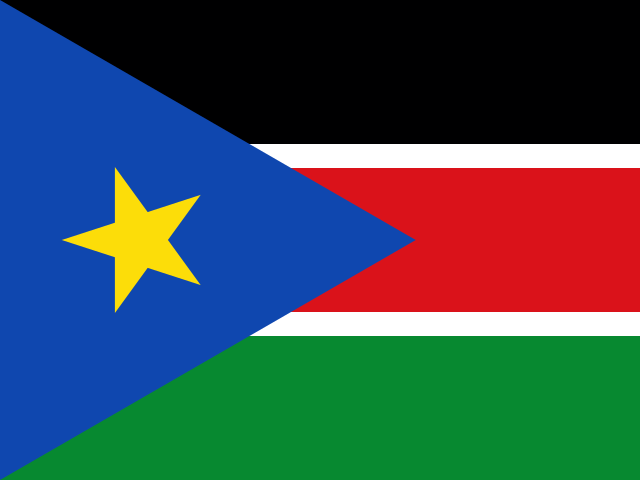
South SudanEmbassy visa—
SpainFree movement—
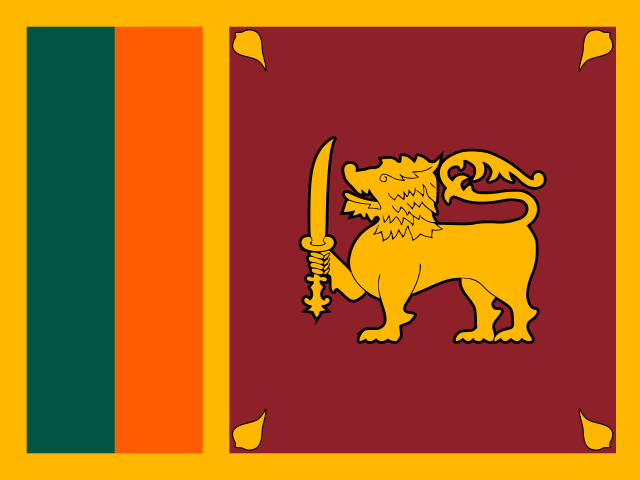
Sri LankaEmbassy visa—
SudanEmbassy visa—
SurinameEmbassy visa—
SwedenFree movement—
SwitzerlandFree movement—
SyriaEmbassy visa—
TaiwanVisa-free90 days
TajikistanEmbassy visa—
TanzaniaEmbassy visa—
ThailandEmbassy visa—
Timor-LesteVisa-free90 days
TogoEmbassy visa—
TongaVisa-free90 days
Trinidad and TobagoVisa-free90 days
TunisiaEmbassy visa—
TurkeyEmbassy visa—
TurkmenistanEmbassy visa—
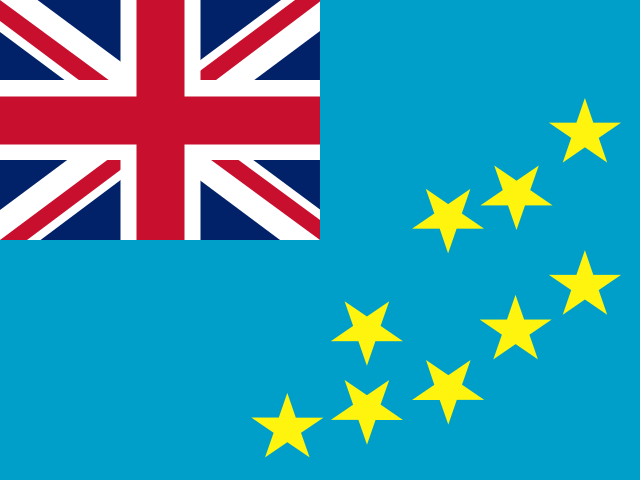
TuvaluVisa-free90 days
UgandaEmbassy visa—
UkraineVisa-free90 days
United Arab EmiratesVisa-free90 days
United KingdomVisa-free90 days
United StatesVisa-free90 days
UruguayVisa-free90 days
UzbekistanEmbassy visa—
VanuatuEmbassy visa—
Vatican CityVisa-free90 days
VenezuelaVisa-free90 days
VietnamEmbassy visa—
YemenEmbassy visa—
ZambiaEmbassy visa—
ZimbabweEmbassy visa—

Stay lengths are for ordinary tourist visits. Click a nationality for its full guide.

Denmark94 of 199 passports visa-freeNetherlands94 of 199 passports visa-freeBelgium94 of 199 passports visa-freeLuxembourg94 of 199 passports visa-freeFrance94 of 199 passports visa-freeSwitzerland94 of 199 passports visa-freeAustria94 of 199 passports visa-freeCzechia94 of 199 passports visa-freePoland94 of 199 passports visa-freeItaly94 of 199 passports visa-freeSpain94 of 199 passports visa-free

Frequently asked questions

Do US citizens need a visa for Germany?

No. The United States is on the EU's visa-exempt list (Annex II of Regulation (EU) 2018/1806), whose nationals can stay up to 90 days in any 180-day period without a visa. Germany is among the countries that will require visa-exempt travellers to have an ETIAS travel authorisation, which is not yet in operation; the official ETIAS website gives the application fee as EUR 20.

How much does a Germany Schengen visa cost?

The Schengen short-stay visa costs €90 for adults and €45 for children aged six to under 12. Under EU visa facilitation agreements, nationals of Armenia, Azerbaijan and Belarus pay €35 and nationals of Cabo Verde 75% of the standard fee. A national visa (category D) costs €75 under the Residence Ordinance, also for multiple entries. The Federal Foreign Office says Schengen visa holders can stay in the entire Schengen Area for up to 90 days in any period of 180 days.

Is ETIAS required to enter Germany?

ETIAS is currently not in operation and no applications are being collected; the EU will announce the start date several months before launch. The official ETIAS website gives the application fee as EUR 20.

How can I move to Germany for work?

Germany's Federal Foreign Office says that if you intend to commence work in Germany you have to apply for a visa with the competent German mission abroad before entering Germany; only nationals of Australia, Canada, Israel, Japan, New Zealand, South Korea and the United States may apply for the necessary residence title after arrival. A national visa (category D) costs €75 under the Residence Ordinance (AufenthV § 46). No official source we could read here sets out the conditions of the EU Blue Card or the Opportunity Card.

How long can I stay in Germany without a visa?

Nationals of the countries on the EU's visa-exempt list can stay up to 90 days in any 180-day period, and the Federal Foreign Office says visits to the Schengen Area by non-EU/EEA nationals are restricted to 90 days in any period of 180 days. EU law says no entry visa may be imposed on EU citizens; Swiss nationals enter on a valid identity card or passport under the EU–Swiss agreement, and the EEA Agreement incorporates the EU free movement directive.

Sources & verification

Every fact on this page is compiled from and periodically re-checked against these official sources:

Something wrong or out of date? Tell us, with the official source